

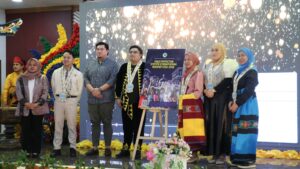
 Officials from BARMM, UNICEF, and CFSI unveil the BARMM’s 10-year Child Protection System Strengthening (CPSS) Roadmap in Marawi City on August 1, 2025, marking a historic step toward a unified, region-wide effort to safeguard children from abuse, exploitation, and neglect. (Photo: MJP/PIA-10)
MARAWI CITY (PIA)—The Bangsamoro government, in partnership with United Nations Children’s Fund (UNICEF) and Community and Family Services International (CFSI), launched a 10-year roadmap on August 1 to improve child protection mechanisms across the region.
The Child Protection System Strengthening (CPSS) Roadmap 2024-2035 outlines coordinated strategies to address child abuse, exploitation, neglect, and violence. It brings together government agencies, humanitarian organizations, law enforcement, academic institutions, and community leaders to build a more systematic and responsive approach to child protection in the Bangsamoro Autonomous Region in Muslim Mindanao (BARMM).
Lawyer Mohammad Muktadir Ahmad Estrella, director general of the Ministry of Social Services and Development (MSSD), noted that child poverty in BARMM remains among the highest in the country, influencing other protection risks.
“We still don’t have a system that ensures that every child in the Bangsamoro region is protected. But Alhamdulillah, we take a positive step as we introduce the 10-year roadmap,” he said.
He acknowledged the contributions of various sectors, saying the roadmap’s success depends on investments beyond human resources, including programs and services.
“This CPSS roadmap is built upon five pillars, meaning it cannot be successful without the success of each of these pillars,” he added.
Coordinated child protection
Andreas Wuestenberg, chief of UNICEF’s Mindanao Field Office, said a well-coordinated system is essential to fulfilling child rights obligations under the UN Convention on the Rights of the Child.
“While efforts to uphold child protection standards are ongoing, variations in compliance and the absence of standardized procedures can impact the consistency and the effectiveness of service delivery. The creation of the Child Protection System Strengthening Roadmap, therefore, is a significant milestone in advancing the Child Protection System in BARMM,” he said.
UNICEF has supported the initiative through its project, Building Community Resilience and Delivery of Essential Services for Post-Conflict Recovery in Lanao del Sur and Marawi City, funded by the European Union and implemented with CFSI. Support includes capacity-building for social workers, community-based case management, improvement of referral mechanisms, and assistance in legal and policy work.
“We would like to congratulate the Ministry of Social Services and Development and all involved supporters and stakeholders on this achievement, as it reflects the strong commitment to safeguard the rights and well-being of every child in the Bangsamoro region,” Wuestenberg said.
Shared responsibility
CFSI Director for Mindanao Programme Noraida Abdullah Karim said the initiative would not have progressed without contributions from various actors, including the security sector. She cited the active involvement of the Philippine National Police’s Child Protection Unit in the planning and consultations.
Karim also recognized the early support of the provincial government of Lanao del Sur, highlighting the passage of the Ranaw Children’s Code and the Gender and Development Code as key steps aligned with the roadmap’s objectives.
Farida Mangcaan, head of CFSI’s Iligan Sub-Office, outlined the roadmap’s focus on policy, service delivery, coordination, and workforce development. She emphasized the importance of adapting policies to local contexts.
“Policies have to be adapted to the changing and evolving environment. We want to engage workers and key stakeholders in promoting child protection through preventive, rehabilitative, restorative, and responsive services,” Mangcaan stressed.
Provincial Vice Governor Mohammad Khalid R. Adiong urged all sectors to take responsibility for child protection, stressing that failure to act would have long-term impacts on future generations in BARMM.
He highlighted key legislative measures passed by the Sangguniang Panlalawigan of Lanao del Sur—the Ranaw Children’s Code and the Ranaw Gender and Development Code—which encompass various local child protection programs.
Adiong also affirmed the provincial government’s full support for regional and NGO-led initiatives that contribute to the welfare of children in BARMM and Lanao del Sur, including the implementation of the CPSS roadmap.
The roadmap is expected to serve as a reference for regional legislation, program implementation, and monitoring systems in the coming years. Key expected outcomes include the enactment of the Bangsamoro Children’s Code, the establishment of a social welfare institute, and expanded access to protection services in remote and underserved areas. (APB/PIA-10/Lanao del Sur)
–
Originally posted by Philippine Information Agency