

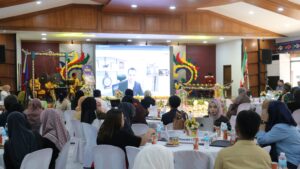
 The Bangsamoro government launches on August 4 the Child Protection System Strengthening (CPSS) Roadmap 2024–2035, a landmark initiative supported by UNICEF and CFSI to address child abuse, neglect, and exploitation in BARMM. UNICEF’s Mindanao Field Office Chief Andreas Wuestenberg hailed the roadmap as a critical step in post-conflict recovery and peacebuilding, aiming to protect children across the region, especially in vulnerable and underserved communities. (Photo: MJP/PIA-10)
MARAWI CITY (PIA)—Child protection is a key element in peacebuilding and development in the Bangsamoro Autonomous Region in Muslim Mindanao (BARMM), according to the United Nations Children’s Fund (UNICEF).
In a video message during the launch of BARMM’s Child Protection System Strengthening (CPSS) Roadmap 2024–2035 on August 1, Andreas Wuestenberg, chief of UNICEF’s Mindanao Field Office, said BARMM faces specific challenges, including a history of conflict, displacement, poverty, and social and cultural practices that increase children’s risks.
As a result, he said, children in the region are more vulnerable to abuse, neglect, child marriage, trafficking, and involvement in armed conflict.
Wuestenberg reported that from 2024 to the present, 221 cases related to child protection and gender-based violence have been monitored and addressed in BARMM.
He added that efforts to meet child protection standards continue, but uneven compliance and lack of standardized procedures affect the consistency and effectiveness of service delivery.
Wuestenberg described the creation of the Child Protection System Strengthening Roadmap as a milestone for advancing child protection in BARMM.
UNICEF supports the process through its initiative “Building Community Resilience and Delivery of Essential Services for Post-Conflict Recovery in Lanao del Sur and Marawi City,” funded by the European Union and in partnership with Community and Family Services International. This support includes training social workers, managing community cases, improving child protection referral systems, and assisting in legal and policy work.
“UNICEF is confident that this roadmap will serve as an excellent guiding framework for shaping laws, policies, practices, and investments in child protection across BARMM,” he added.
Key goals in the roadmap include passing the Bangsamoro Children’s Code, creating a social welfare institute to develop worker skills, and expanding child protection services, particularly in remote and disadvantaged areas.
“Every Bangsamoro child has the right to grow up free from violence, neglect, and exploitation,” he said. “Together, we can make this a reality.” (APB/PIA-10/Lanao del Sur)
–
Originally posted by Philippine Information Agency