

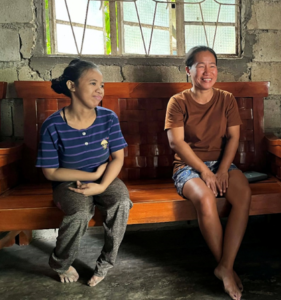
 In Linao Norte, Tuguegarao City, Cagayan Province, 26-year-old Rose lives with her older sister Janet and her family. Rose has a physical disability that has affected her since birth, severely limiting her mobility. While she is able to have some form of independence, she largely moves around with her knees and, at times, by crawling. As a child, this meant that she was unable to continue her education beyond kindergarten. With no formal schooling and no income of her own, Rose grew up entirely dependent on her sister for her daily needs. She also had limited opportunities for social and economic participation in the wider community. Compounding her vulnerability and risks to various hazards, their home is situated in an area prone to flooding – particularly during heavy rains, where she, her sister, and their family need to evacuate to their neighbor’s two-story house until flooding subsides.
In spite of these challenges, Rose continues to work hard to contribute to her family whenever she can. Whenever there was extra money in the household, Rose would quietly ask Janet to buy gummy worms from the stores, which she will then resell to neighborhood children. It is a small act, but it revealed the heart of someone who continued to make the most of what they had, giving back in whatever way she could. Still, without capital, limited mobility, or access to formal livelihood opportunities, Rose remained economically invisible.
“Thank you very much for giving me the opportunity to help my older sister and her family. Because of this, I found something meaningful to do. Thank you very much, as this has been a big help to all of us.”
CFSI, with support from the Australian Government, implements the Cagayan Recovery Project (CRP) in the Tuguegarao City and the Municipalities of Enrile, Solana, and Iguig, to support the sustainable recovery and promote resilience in households most affected by recurrent flooding in communities around the Cagayan River. The project has four components: (1) Sustainable Livelihoods, (2) Disaster Risk Reduction, (3) Social Protection, and (4) Mental Health and Psychosocial Support (MHPSS). Through the Sustainable Livelihoods component, CFSI provides livelihood support to the most vulnerable individuals to help meet basic household expenses and to increase their resiliency for future shocks.
Rose and her family were among those identified as most vulnerable in their barangay. Recognizing her situation and her determination to contribute to her needs as well as her family’s, CFSI worked with Rose to identify her strengths, priorities, and needs. As a result, in January 2026, CFSI provided Rose and her family with start up capital amounting to ₱10,000 to establish a sari-sari store located in front of their house, which Rose immediately started managing day to day. This allowed Rose to have a fresh start, with a livelihood that is accessible and convenient for her.
“Nagpapasalamat kami sa CFSI sa pagbibigay ng negosyo para sa aking kapatid at sa aming pamilya, malaking tulong ito sa amin lalo na kay Rose, hindi na siya naboboring, hindi na rin siya nagtitinda ng gummies, sari-sari na ang binebenta niya. Malaking tulong sa amin sa pang araw-araw, pambayad ng kuryente, pamasahe ng mga anak ko at ibang bayarin.” her sister shared.
(“We are deeply grateful to CFSI for giving my sibling the opportunity to start a livelihood. It has been a great help to our family, especially to Rose. She used to have limited means, only selling gummy, but now she sells a variety of goods. This is a big help to us in our daily needs – for paying electricity, transportation fare for my children and other expenses.”)
This opportunity became a turning point in her life. During monitoring activities conducted by CFSI in February 2026, the results were already evident. Through proper management and reinvestment of daily earnings, the family had expanded their inventory and added high demand items such as rice and tray eggs. The store now earns approximately ₱2,000 daily, which they use to restock goods twice a week. From someone who once depended entirely on her sister’s support, Rose now contributes to household expenses including electricity and water bills. More than the income, the store has given Rose something even more meaningful: a renewed sense of purpose, a space to grow, and the feeling of belonging in her own community. Rose’s story is a powerful testament of the importance of disability-inclusive programming and to the transformative impact of livelihood support on individuals who have been invisible to economic opportunity.
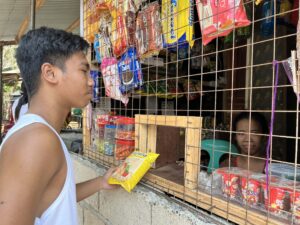 “Maraming-maraming salamat po dahil binigyan niyo ako ng pagkakataon na makatulong sa ate ko, sa pamilya po nila. Dahil po dito hindi na ako naboboring, maraming salamat po dahil malaking tulong siya sa aming lahat.” Rose expressed.
(“Thank you very much for giving me the opportunity to help my older sister and her family. Because of this, I found something meaningful to do. Thank you very much, as this has been a big help to all of us.”)
Rose is now a source of inspiration in her barangay. She hopes to continue growing her store, adding more products over time, and eventually being known not as someone who needs help but as someone who helps others. She also hopes her story can encourage other persons with disabilities to believe that, regardless of their limitations, they can build something on their own. Her journey from dependence to contribution reflects not only a personal success, but a brighter and more dignified future for her family.
_
Story by: Mica Bunagan | Community Organizer of Sub-Office Tuguegarao