

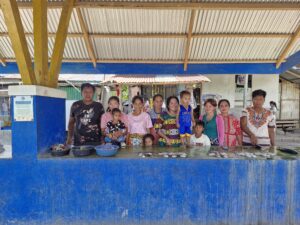
 Gulloh Kalingalan, 63, has spent most of his life by the sea. As a leader of the Sama Bajau tribe in Barangay Sucuban, Municipality of Omar, Sulu, he has long carried the responsibility of guiding his community through hardship and hope. Sucuban is a quiet coastal fishing village where generations of Sama Bajau families have depended on the sea for survival, relying on payao, a traditional and sustainable method using anchored bamboo rafts covered with palm fronds to attract pelagic fish like tuna and mackerel.
For all its richness, life in Sucuban had its challenges. When selling their catch, the Sama Bajau had no proper trading space. They just lay the fishes and seaweeds on plastic sheets on the ground, their goods exposed to heat, rain, and dirt. They knew a proper market would give them a safe space to trade and become a hub for both economic life and community connection.
Recognizing the need, the community suggested a more conducive space when Barangay Sucuban was chosen to receive climate-resilient and income-diversified livelihood support under the Birth Registration Project (BRP), implemented by CFSI. During community consultations, Gulloh and his fellow Sama Bajau members made their most urgent need clear: a flea market. CFSI took steps to meet this need, helping establish the Hap Allaw Sama Bajau Sucuban Association, managing the market and guiding members to improve their living conditions through steady vending.
Expressing his gratitude, Mr. Gulloh said “Tagna asigpit kami halam katanaman kami pag dagangan saga bay ta’ah kami ma dilaut, bang angulan abase base kami, sah battinaan, asanyang na pasal aniya na tabu-tabu kami, aponnoh mesa-mesa heh daying. A pun pun kami kamemon mahe. Illaw-illaw paglanuan kami maka paruli kami tabu-tabu itu bay pamuwan bih.”
(“Before, we struggled to find a proper place to sell our catch; whenever it rained, we got soaked and our goods were at risk. But now, life is much more peaceful. We have our own market. The tables are always full of fish, and we are all together there selling. We keep the flea market clean every day and will always value and take care of it.”)
With a shared space they proudly call their own, the Sama Bajau are creating a more organized way of trading, bringing the community together around a common goal of improving their lives.. They sell fish, shells, and seaweeds not only within the barangay but also to neighbors from other parts of Omar.
The flea market has boosted income stability earning at least additional PHP 500.00 per household and reduced exposure to weather risks. It is designed as a dedicated community space for the Sama Bajau, fostering cooperation rather than competition, while strengthening shared goals, mutual support, and connections in the community. Members of the same household including parents, children, and relatives, now work side-by-side, helping prepare the catch, transporting goods, managing stalls, and keeping the area clean. Daily interaction at the market builds trust, teaches shared responsibility, and keeps family bonds strong. Everyone has a role, and every success is celebrated together. As Gulloh often emphasizes, “Start small but stay consistent. Growth comes with persistence.” Beyond livelihood, progress is also felt in rights and security.
Gulloh dreams of a peaceful, productive community where every Sama Bajau has access to jobs, education, and social protection and happily notes that all members of his family now hold official certificates of live birth, a solid foundation for their future
The initiative is part of the Birth Registration Project (BRP), implemented by CFSI in partnership with UNHCR Philippines under the Initiative for Promoting Digital Birth Registration in the Bangsamoro Autonomous Region of Muslim Mindanao (BARMM) and Sulu with generous funding from the Embassy of Japan in the Philippines 在フィリピン日本国大使館 The initiative aims to facilitate the birth registration of 30,000 individuals across 50 municipalities. The climate-resilient and income-diversified livelihood support to 15 Sama Bajau communities in Sulu and Tawi-Tawi and forms part of the efforts to sustain the initiative
—
Meriam Tedding, Project Coordinator/Head of Office